


Knowing that UAE Corporate Tax is charged at 0 percent and 9 percent only tells part of the story. The number those rates actually get applied to, taxable income, is not the same figure sitting in a business’s profit and loss statement. Corporate Tax calculation is the process that bridges the two, and understanding each step of that process is what lets a business arrive at a number it can actually stand behind when it files its return.
What Is Taxable Income?
Taxable income is the specific figure UAE Corporate Tax is calculated on. It is derived from a taxable person’s accounting net profit or loss for a Tax Period, after applying the specific adjustments, exemptions, deductions, and reliefs required under Federal Decree-Law No. 47 of 2022. Taxable income is not the same as revenue, and it is not automatically the same as the profit figure shown in a business’s financial statements either, since several categories of item are treated differently for Corporate Tax purposes than they are for accounting purposes.
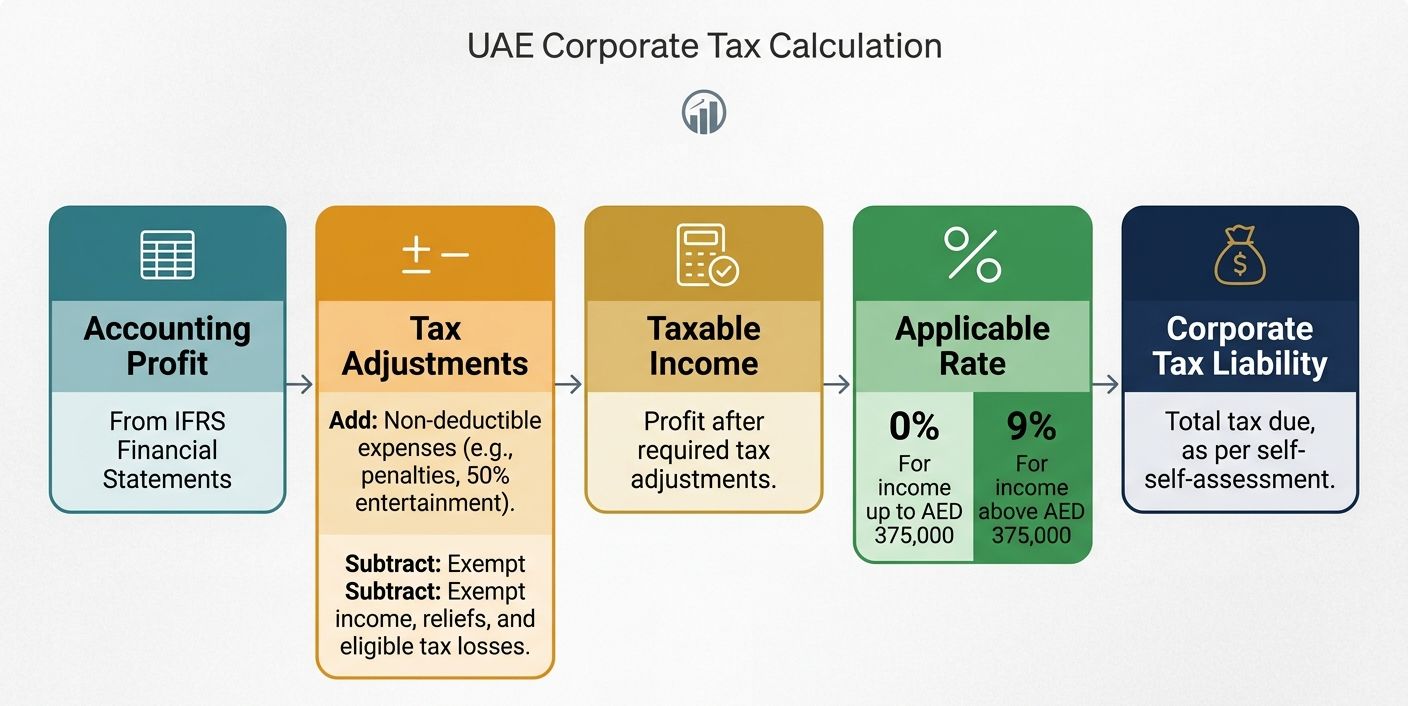
Accounting Profit vs Taxable Income
Accounting profit is the net profit or loss a business reports in its financial statements, prepared under IFRS or another applicable accounting standard. It reflects the business’s actual financial performance based on standard accounting rules.
Taxable income starts from that same accounting profit figure but is not identical to it. Certain expenses recognized in the accounts are not deductible for Corporate Tax purposes and need to be added back. Certain income recognized in the accounts is exempt from Corporate Tax and needs to be removed. Specific reliefs, such as available tax losses, can further reduce the figure. The result of applying all of these adjustments to accounting profit is taxable income, the number the Corporate Tax rates are actually applied to.
Need Expert Advice?
Contact the team at Farahat & Co. for professional support and expert insights for businesses operating in the UAE.
Tax Adjustments
Tax adjustments are the specific additions to, and deductions from, accounting profit required to move from that accounting figure to taxable income. Additions typically include non-deductible expenses that were recorded in the accounts but are disallowed for tax purposes, such as certain fines, penalties, and non-qualifying donations. Deductions typically include exempt income that was recognized in the accounts but excluded from the tax calculation, such as qualifying dividends.
Other adjustments address timing differences between accounting and tax treatment, and specific rules under the Corporate Tax Law covering areas such as interest deductibility limitations and the treatment of certain provisions. Correctly identifying every required adjustment is what separates an accurate taxable income calculation from one that simply copies the accounting profit figure across unchanged.
Exempt Income
Exempt income refers to specific categories of income a taxable person can exclude from its taxable income calculation, even though the business itself remains fully subject to Corporate Tax. This generally includes qualifying dividends and profit distributions received from other UAE taxable persons or qualifying shareholdings, and certain capital gains arising from the disposal of a qualifying participating interest, subject to ownership and holding period conditions.
Income attributable to a qualifying foreign Permanent Establishment can, subject to an election and specific conditions, also be excluded where that income has already been taxed abroad. Identifying exempt income correctly matters directly for the calculation, since including it in taxable income would overstate a business’s actual Corporate Tax liability.
Deductible Expenses
Deductible expenses are legitimate business expenses incurred wholly and exclusively to derive taxable income, generally deductible in calculating taxable income, subject to specific limitations the Corporate Tax Law sets for certain categories. Ordinary operating costs, staff salaries, rent, utilities, and similar day-to-day business expenses generally fall into this category, provided they genuinely relate to the business’s income-generating activity.
Interest expenditure is generally deductible but subject to specific limitations on net interest deductions, particularly relevant to related party financing. Entertainment expenditure, such as client hospitality, is generally subject to a specific partial deduction limitation rather than being fully deductible. Capital expenditure is generally not deducted in full immediately, but recognized over time through depreciation or amortization in line with the asset’s useful life.
Also check: Corporate Tax Services in UAE
Non-Deductible Expenses
Certain expenses are specifically disallowed for Corporate Tax purposes regardless of whether they relate to genuine business activity. This includes administrative penalties and fines, donations or gifts made to entities that are not qualifying public benefit entities, and Corporate Tax itself, which cannot be deducted as an expense in arriving at taxable income.
Where an expense serves a mixed business and personal purpose, only the portion genuinely attributable to the business is deductible, with the personal element treated as non-deductible and added back in the calculation.
Tax Losses
A tax loss arises where a taxable person’s allowable deductions exceed its taxable income for a Tax Period, resulting in a negative taxable income figure. Tax losses can generally be carried forward and used to offset taxable income in future Tax Periods, subject to a cap on how much of a future period’s taxable income can be offset in a single period, and subject to ownership continuity conditions between the period the loss arose and the period it is used.
A business with carried-forward tax losses available should apply them as part of its taxable income calculation for the current period, reducing the amount ultimately subject to the 0 percent and 9 percent rates.
Reliefs
Beyond exempt income and tax losses, certain elective reliefs can reduce a business’s Corporate Tax position further. Small Business Relief allows an eligible Resident Person with revenue at or below AED 3,000,000 to be treated as having no taxable income at all for the period, available only for Tax Periods ending on or before 31 December 2026. Business Restructuring Relief can defer the Corporate Tax consequences of certain qualifying mergers and reorganizations. Each of these reliefs needs to be actively elected and its conditions confirmed as met; none apply automatically simply because a business’s circumstances might qualify.
The Corporate Tax Calculation Formula
Bringing the above together, UAE Corporate Tax calculation follows a consistent formula:
Accounting Profit + Non-Deductible Expenses − Exempt Income − Reliefs and Tax Losses = Taxable Income
Taxable Income × Applicable Rate (0% up to AED 375,000; 9% above) = Corporate Tax Liability
Step-by-Step Corporate Tax Calculation
Applying this formula in practice follows a consistent sequence. Start with the business’s accounting profit for the Tax Period, taken from its finalized financial statements. Add back any non-deductible expenses recognized in the accounts, such as fines, penalties, or non-qualifying donations. Deduct any exempt income recognized in the accounts, such as qualifying dividends. Apply any available reliefs or carried-forward tax losses the business is eligible to use. The result is taxable income. Finally, apply the 0 percent rate to taxable income up to AED 375,000 and the 9 percent rate to any amount above that threshold, and add the two results together to arrive at the final Corporate Tax liability for the period.
Check: Corporate Tax Audit Services
Worked Example: Simple UAE Business
A UAE consulting business reports accounting profit of AED 500,000 for its Tax Period. Its accounts include AED 20,000 of non-deductible entertainment expenditure disallowed under the Corporate Tax Law, which must be added back. It has no exempt income, no available tax losses, and does not elect Small Business Relief.
Taxable income is calculated as AED 500,000 plus AED 20,000, equaling AED 520,000. Applying the rates, the first AED 375,000 is taxed at 0 percent, producing AED 0. The remaining AED 145,000 is taxed at 9 percent, producing AED 13,050. The business’s total Corporate Tax liability for the period is AED 13,050.
Also check: Corporate Tax Audit in UAE
Worked Example: Business With a Prior Year Tax Loss
A UAE trading business reports accounting profit of AED 900,000 for the current Tax Period. Its accounts include AED 40,000 of non-deductible expenses, which must be added back. It received AED 150,000 in qualifying dividends from another UAE company, which is deducted as exempt income. The business also has AED 200,000 of carried-forward tax losses available from a prior period, which it applies in full against the current period.
Taxable income is calculated as AED 900,000 plus AED 40,000, minus AED 150,000, minus AED 200,000, equaling AED 590,000. Applying the rates, the first AED 375,000 is taxed at 0 percent, producing AED 0. The remaining AED 215,000 is taxed at 9 percent, producing AED 19,350. The business’s total Corporate Tax liability for the period is AED 19,350.
Also check: Accounting & Bookkeeping Services
Free Zone Calculation Overview
Calculating Corporate Tax for a Qualifying Free Zone Person follows a modified version of the same formula, with one key difference: rather than applying the 0 percent and 9 percent bands to a single combined taxable income figure, a QFZP needs to separate its taxable income into Qualifying Income and non-qualifying income before applying rates.
Qualifying Income is taxed entirely at 0 percent, regardless of amount. Any taxable income that does not meet the definition of Qualifying Income is taxed at the full 9 percent rate, without benefiting from the AED 375,000 threshold that applies under the standard rate structure. A QFZP’s overall Corporate Tax liability is therefore the sum of 9 percent applied to its non-qualifying taxable income only, with its Qualifying Income contributing nothing to the liability. Correctly classifying income between these two categories is the critical first step in any QFZP calculation, and is covered in full in our dedicated guide to Qualifying Free Zone Person status.
Also check: Corporate Tax Services in UAE
Frequently Asked Questions (FAQs)
How is Corporate Tax calculated in the UAE?
What is the difference between accounting profit and taxable income?
What expenses need to be added back when calculating taxable income?
Can tax losses reduce a Corporate Tax calculation?
Is Corporate Tax calculated on revenue or profit?
How is Corporate Tax calculated for a Qualifying Free Zone Person?
Does exempt income need to be included in a Corporate Tax calculation?
Need Expert Advice?
Contact the team at Farahat & Co. for professional support and expert insights for businesses operating in the UAE.
How Farahat & Co. Can Help
Accurate Corporate Tax calculation depends on the full picture, rates, deductions, exemptions, and reliefs together. For a complete overview of UAE Corporate Tax, see our complete UAE Corporate Tax guide.
Farahat & Co. helps UAE businesses calculate taxable income accurately, applying the correct adjustments, exemptions, and reliefs before Corporate Tax rates are applied.
Contact Farahat & Co. today to discuss your Corporate Tax requirements.
