


Corporate Tax became a permanent part of doing business in the UAE for financial years beginning on or after 1 June 2023. The regime applies a 0% rate on taxable income up to AED 375,000 and a 9% rate above that threshold, with Qualifying Free Zone Persons subject to a separate 0% treatment on their qualifying income. It applies broadly, to UAE companies, many foreign entities with a UAE presence, and, under specific conditions, to individuals conducting business.
Understanding registration, taxable income, deductions, exemptions, and compliance requirements matters for every business operating in the UAE, since Corporate Tax obligations apply regardless of whether a business ultimately owes any tax. This guide covers the complete UAE Corporate Tax framework: who it applies to, how the rates work, how taxable income is calculated, what can be deducted, how Free Zones and individuals are treated, and what registration, filing, payment, and compliance actually require in practice.
1. What Is Corporate Tax in the UAE?
What Is Corporate Tax?
Corporate Tax is a direct tax imposed on the net income or profit of corporations and other businesses. In the UAE, Corporate Tax is levied under Federal Decree-Law No. 47 of 2022 on the Taxation of Corporations and Businesses, applying to the taxable income a business earns during a Tax Period, generally its financial year.
What Does Corporate Tax Mean?
In practical terms, Corporate Tax means that a business’s profit, not its revenue, becomes subject to tax once specific adjustments required under the Corporate Tax Law have been applied. The term is closely related to what is sometimes called corporate income tax or business profits tax internationally, all describing the same underlying concept: a tax charged on taxable income rather than on total sales or turnover.
Why Did the UAE Introduce Corporate Tax?
The UAE introduced Corporate Tax to align with international tax standards and support its position as a globally cooperative, transparent business hub. The regime reflects the UAE’s commitment to preventing harmful tax practices, meeting international tax transparency standards, and diversifying government revenue beyond oil in support of long-term economic development. It also reflects the UAE’s participation in international cooperation frameworks addressing base erosion and profit shifting, positioning the country’s tax system in step with major global economies rather than as an outlier.
When Did UAE Corporate Tax Start?
UAE Corporate Tax applies to financial years beginning on or after 1 June 2023. The specific date a business’s Corporate Tax obligations begin depends on its own financial year: a company with a calendar-year financial year became subject to Corporate Tax from 1 January 2024, while a company with a financial year already running from, for example, 1 July, became subject from 1 July 2023. This is what the Corporate Tax Law refers to as a Tax Period, the specific financial year against which taxable income is calculated.
Is Corporate Tax the Same as VAT?
No. Corporate Tax and VAT are entirely separate taxes that can both apply to the same business. Corporate Tax is a direct tax on taxable income or profit. VAT is an indirect tax on taxable supplies of goods and services, currently charged at 5 percent under Federal Decree-Law No. 8 of 2017. A business can be registered for, and liable to pay, both taxes simultaneously, since one taxes profit and the other taxes transactions. The introduction of Corporate Tax did not replace or reduce VAT obligations in any way.
Also check: Corporate Tax Services in UAE
2. UAE Corporate Tax Law and Regulatory Framework
UAE Corporate Tax rests on a layered legal framework that has continued to develop since the Law was first issued, through subsequent Cabinet Decisions, Ministerial Decisions, and Federal Tax Authority guidance.
Federal Decree-Law No. 47 of 2022
Federal Decree-Law No. 47 of 2022 on the Taxation of Corporations and Businesses is the primary legislation establishing UAE Corporate Tax. It sets out the core concepts of the regime, including taxable persons, taxable income, rates, exemptions, and the general obligations businesses must meet, forming the legal foundation that every subsequent decision and piece of guidance builds on.
Role of the Federal Tax Authority
The Federal Tax Authority is the government body responsible for administering, collecting, and enforcing UAE Corporate Tax. The FTA manages registration through its EmaraTax platform, receives and processes Corporate Tax returns, issues public clarifications and guidance on how the Law applies in practice, and carries out audits and enforcement activity where necessary.
Role of the Ministry of Finance
The Ministry of Finance is responsible for UAE tax policy at a broader level, issuing Ministerial Decisions that provide detailed rules under the Corporate Tax Law, and representing the UAE in international tax cooperation matters, including the country’s participation in the OECD’s global tax transparency and anti-base-erosion initiatives.
Cabinet and Ministerial Decisions
Much of the operational detail behind UAE Corporate Tax is set out not in the Law itself, but in subsequent Cabinet Decisions and Ministerial Decisions, covering specific matters such as Small Business Relief thresholds, Qualifying Free Zone Person conditions, transfer pricing documentation thresholds, and administrative penalties. These decisions are issued and updated as the regime matures, meaning the practical rules governing a specific topic often sit in a decision issued well after the original Law.
FTA Guides and Public Clarifications
The FTA supplements the legislation with detailed guides and public clarifications, addressing specific interpretive questions and providing worked examples of how particular provisions apply. Because the UAE Corporate Tax framework continues to be actively developed, with new guidance issued through 2026, businesses and advisors should treat FTA guides and public clarifications as a live, evolving source, checking current guidance rather than relying on earlier summaries that may have since been updated or superseded.
Need Expert Advice?
Contact the team at Farahat & Co. for professional support and expert insights for businesses operating in the UAE.
3. Who Is Subject to UAE Corporate Tax?
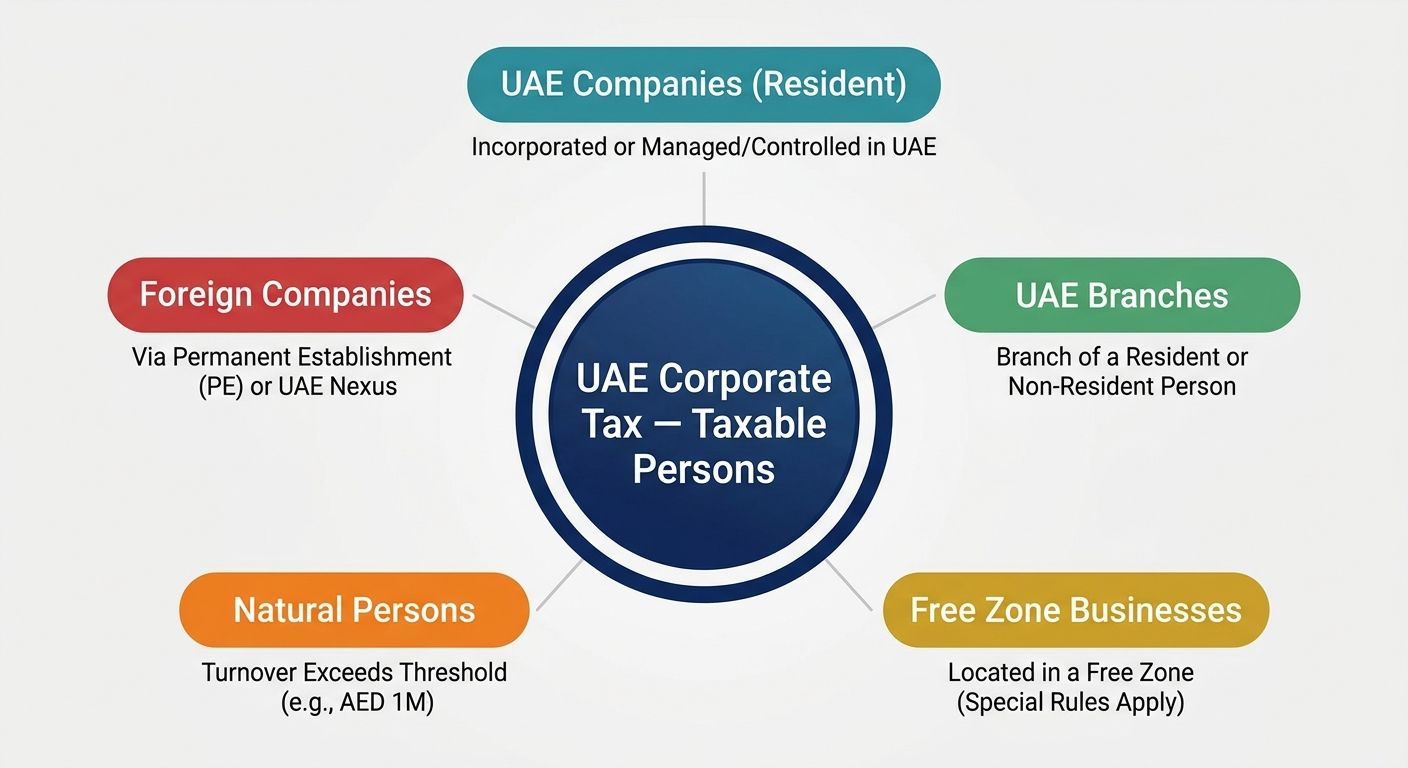
UAE Corporate Tax applies to a broad range of taxable persons, defined primarily through incorporation, residence, or a UAE presence rather than any single narrow category.
UAE Companies
Companies incorporated or otherwise established in the UAE, whether onshore or in a free zone, are generally treated as Resident Persons and are subject to Corporate Tax on their worldwide income, subject to the specific rules applicable to Free Zone businesses covered later in this guide.
Foreign Companies
Foreign juridical persons can become subject to UAE Corporate Tax where they are effectively managed and controlled in the UAE, or where they have a UAE Permanent Establishment, generally taxed on the income attributable to that UAE presence rather than their entire worldwide income.
UAE Branches
A UAE branch of a foreign company is generally treated as an extension of that foreign company rather than a separate legal entity, but it can still trigger UAE Corporate Tax obligations for the foreign company through the Permanent Establishment concept, covered in more detail later in this guide.
Natural Persons
Natural persons conducting business or business activity in the UAE can become subject to Corporate Tax, but only where their business turnover exceeds a specified threshold. Individuals earning salary income or personal investment income outside the scope of a licensed business activity generally fall outside Corporate Tax entirely.
Sole Proprietorships
A sole proprietorship, a business owned and operated by a single natural person without a separate corporate structure, is assessed under the same natural person rules described above, based on the individual’s business turnover rather than any separate corporate threshold.
Partnerships
Unincorporated partnerships are generally treated as transparent for Corporate Tax purposes, meaning the partnership itself is not typically the taxable person; instead, each partner is generally taxed on their distributive share of the partnership’s income, subject to specific elections and conditions under the Law.
Free Zone Businesses
Free Zone businesses are subject to UAE Corporate Tax but may qualify for a separate 0% rate on qualifying income as a Qualifying Free Zone Person, a distinct regime covered in detail in Section 11 of this guide. Free Zone status alone does not create an automatic exemption from Corporate Tax.
Government and Other Special Entities
Government entities and certain other special categories of person receive specific treatment under the Corporate Tax Law, which may include automatic exemption or exemption subject to conditions, covered in the following section on exempt persons.
4. Who Is Exempt from UAE Corporate Tax?
Certain categories of person are treated as exempt from UAE Corporate Tax, though the path to exemption differs depending on the category involved.
Automatically Exempt Persons
Government entities and government-controlled entities generally qualify for automatic exemption, without needing to apply or meet ongoing conditions beyond their basic status, reflecting their role in delivering public functions rather than conducting commercial business activity for private benefit.
Exempt Persons Subject to Conditions
Other categories are exempt only where specific conditions continue to be met. Extractive businesses and non-extractive natural resource businesses can qualify for exemption where they meet conditions tied to their specific activities and any separate Emirate-level taxation they are subject to. Qualifying investment funds, and certain pension or social security funds, can also qualify for exemption where they satisfy the conditions set out in the Law and related decisions.
Persons Requiring Application or Approval
Qualifying public benefit entities generally need to be listed by Cabinet Decision, or otherwise meet a formal application or approval process, before exemption applies. Certain UAE subsidiaries wholly owned by exempt persons can also qualify for exemption, subject to meeting the relevant conditions and, in some cases, a formal application process.
Corporate Tax Exemptions vs Exempt Income
A distinction worth stating clearly: being an exempt person is not the same as receiving exempt income. An exempt person generally falls outside the Corporate Tax regime entirely for its exempt activities. Exempt income, covered in detail in Section 8 of this guide, refers to specific categories of income, such as qualifying dividends or capital gains, that a taxable person, otherwise fully subject to Corporate Tax, can exclude from its taxable income calculation. A business does not need to be an exempt person to benefit from exempt income treatment on specific items.
5. UAE Corporate Tax Rates
0% Corporate Tax Rate
A 0% rate applies to the portion of a taxable person’s taxable income up to AED 375,000. This 0% band is part of the permanent rate structure under the Corporate Tax Law, distinct from the separate, time-limited Small Business Relief mechanism covered in Section 10.
9% Corporate Tax Rate
A 9% rate applies to taxable income above AED 375,000. This is the standard rate applicable to most taxable persons once their taxable income exceeds the 0% threshold.
Read: Guide To UAE Corporate Tax Rates
Corporate Tax Rate for Qualifying Free Zone Persons
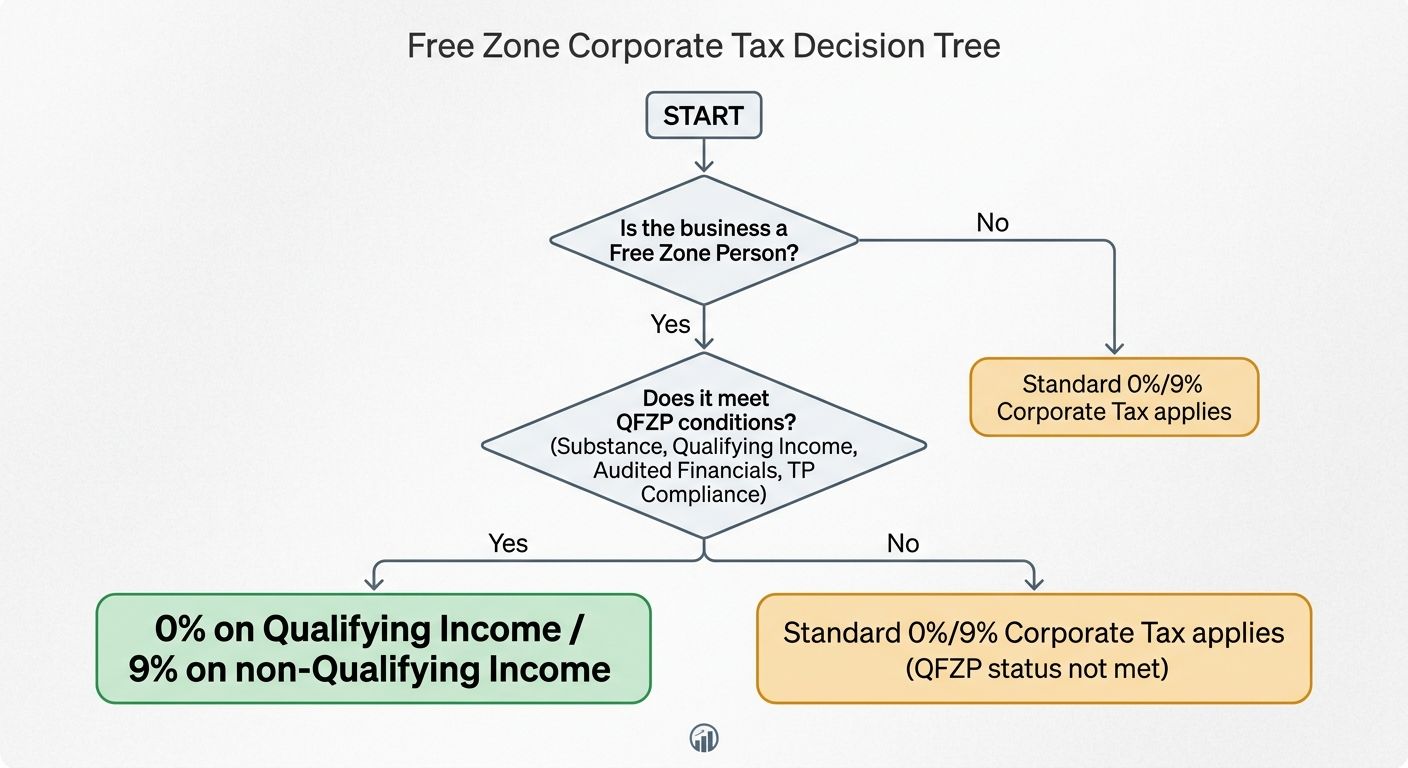
A Qualifying Free Zone Person is subject to a 0% rate on its Qualifying Income, and the standard 9% rate on any Taxable Income that does not meet the definition of Qualifying Income. This regime operates separately from the standard 0 percent/9 percent bands applicable to other taxable persons, and is covered in full detail in Section 11.
How Corporate Tax Rates Apply to Taxable Income
For a standard taxable person, the 0% and 9% rates apply progressively to taxable income, meaning the first AED 375,000 of taxable income is taxed at 0 percent regardless of how much taxable income the business earns in total, with only the portion above that threshold taxed at 9 percent.
| Taxpayer Category | Rate | Applies To |
|---|---|---|
| Standard taxable person | 0% | Taxable income up to AED 375,000 |
| Standard taxable person | 9% | Taxable income above AED 375,000 |
| Qualifying Free Zone Person | 0% | Qualifying Income |
| Qualifying Free Zone Person | 9% | Taxable Income that is not Qualifying Income |
A separate top-up tax regime applies to very large multinational groups under the UAE’s implementation of the OECD’s global minimum tax framework, but this affects only a small number of the largest multinational enterprises and does not change the standard 0 percent/9 percent structure described above for the vast majority of UAE businesses.
6. Taxable Income Under UAE Corporate Tax
What Is Taxable Income?
Taxable income is the figure Corporate Tax is actually calculated on, derived from a taxable person’s accounting net profit or loss for a Tax Period, after applying the specific adjustments required under the Corporate Tax Law.
Accounting Profit vs Taxable Income
Accounting profit is the net profit or loss reported in a business’s financial statements, prepared under applicable accounting standards. Taxable income starts from that accounting figure but is not identical to it, since certain items recognized for accounting purposes are treated differently for Corporate Tax purposes, either added back, deducted, or excluded entirely, following the adjustments the Corporate Tax Law requires.
Tax Adjustments
Tax adjustments are the specific additions to, and deductions from, accounting profit required to arrive at taxable income. These adjustments address items such as non-deductible expenses that must be added back, exempt income that must be removed, and specific reliefs or allowances the Law permits.
Exempt Income
Exempt income refers to specific categories of income that a taxable person can exclude from its taxable income calculation, such as qualifying dividends and certain capital gains, covered in full in Section 8 of this guide.
Deductible Expenses
Deductible expenses are legitimate business expenses incurred wholly and exclusively to derive taxable income, generally deductible subject to the specific rules and limitations set out in the Corporate Tax Law, covered in detail in Section 7.
Non-Deductible Expenses
Certain categories of expense are specifically disallowed under the Corporate Tax Law regardless of whether they were incurred for business purposes, including items such as donations to non-qualifying entities and specific penalties, also covered in Section 7.
7. Corporate Tax Deductions and Allowable Expenses
What Expenses Are Deductible?
The general principle under UAE Corporate Tax Law is that legitimate business expenses incurred wholly and exclusively to derive taxable income are deductible, subject to any specific limitations the Law sets out for particular expense categories.
Read: Guide To Corporate Tax Deductions in the UAE
What Expenses Are Not Deductible?
Certain expenses are specifically excluded from deduction regardless of their business purpose, including administrative penalties and fines, donations or gifts made to entities that are not qualifying public benefit entities, and, generally, Corporate Tax itself, which cannot be deducted as an expense in calculating taxable income.
Business vs Personal Expenses
Expenses must be incurred wholly and exclusively for business purposes to be deductible. Where an expense serves a mixed business and personal purpose, only the portion genuinely attributable to the business is generally deductible, with the personal element excluded.
Capital Expenditure and Depreciation
Capital expenditure, spending on assets expected to provide benefit over multiple periods rather than being consumed immediately, is generally not deducted in full in the period incurred. Instead, its cost is typically recognized over time through depreciation or amortization, in line with the accounting treatment applied and any specific rules the Corporate Tax Law sets out for particular asset categories.
Interest Deductibility
Interest expenditure is generally deductible, but the Corporate Tax Law includes specific limitations on net interest deductions, particularly relevant to related party financing arrangements, designed to prevent excessive interest deductions from eroding the UAE tax base.
Entertainment Expenses
Entertainment expenditure, such as client hospitality, is generally subject to a specific partial deduction limitation under the Corporate Tax Law, rather than being either fully deductible or fully disallowed, reflecting the mixed business and goodwill nature typically associated with this category of spend.
8. Corporate Tax Exempt Income
Separate from the exempt persons covered in Section 4, certain categories of income are excluded from a taxable person’s taxable income calculation even though the person itself remains fully subject to Corporate Tax.
Qualifying dividends and profit distributions received from other UAE taxable persons, or from qualifying shareholdings under the participation exemption rules, are generally excluded from taxable income, avoiding the same profit being taxed multiple times as it moves between related entities. Certain capital gains arising from the disposal of a qualifying participating interest can similarly be excluded, subject to ownership percentage and holding period conditions set out in the Law.
Income attributable to a qualifying foreign Permanent Establishment can, subject to an election and specific conditions, be excluded from a UAE taxable person’s taxable income where that income has already been subject to tax in the foreign jurisdiction. Other categories of exempt income exist under the Law for specific circumstances, generally subject to conditions that need to be assessed against a taxpayer’s specific facts rather than applied automatically.
This distinction between exempt persons and exempt income matters directly for calculating taxable income: a fully taxable business still needs to correctly identify and exclude any exempt income it has earned before applying the Corporate Tax rates to what remains.
9. Corporate Tax Losses
A Corporate Tax loss arises where a taxable person’s allowable deductions exceed its taxable income for a Tax Period, resulting in a negative taxable income figure for that period rather than an amount subject to tax.
Tax losses can generally be carried forward and offset against taxable income in future Tax Periods, subject to conditions set out in the Corporate Tax Law. The Law generally caps the amount of taxable income in a future period that can be offset using carried-forward losses, meaning a business with substantial accumulated losses may not be able to reduce a future period’s taxable income to zero using losses alone in a single period.
Using carried-forward losses is also subject to ownership continuity conditions, generally requiring that the same person or persons continue to own at least a specified percentage of the business between the period the loss arose and the period it is being used, to prevent loss-making shell companies from being acquired purely to shelter unrelated future profits. Tax losses can, subject to specific conditions, be transferred between certain related UAE group companies, and specific rules also govern how losses are treated in the context of business restructuring and Corporate Tax Groups, covered later in this guide.
The Federal Tax Authority issued a dedicated Corporate Tax Losses guidance bulletin in June 2026, reflecting how this remains an area of ongoing clarification. Businesses relying on carried-forward losses, transferred losses, or loss treatment in a restructuring should check current FTA guidance before finalizing a position, rather than relying on general principles alone, given how technical and fact-specific loss utilization rules can become.
10. Small Business Relief
What Is Small Business Relief?
Small Business Relief is an elective relief under Article 21 of the Corporate Tax Law that allows an eligible Resident Person to be treated as having derived no taxable income for a Tax Period, resulting in an effective 0 percent Corporate Tax outcome for that period.
Eligibility and Revenue Threshold
Small Business Relief is available to Resident Persons whose revenue for the relevant Tax Period, and every previous Tax Period since the Corporate Tax regime began, does not exceed AED 3,000,000, the threshold set under Ministerial Decision No. 73 of 2023. Exceeding this threshold in any single Tax Period permanently disqualifies a business from claiming the relief in any later period, even if revenue subsequently falls back below the threshold.
Small Business Relief is not available to members of a Multinational Enterprise Group required to prepare Country-by-Country Reports, generally groups with consolidated global revenue of AED 3.15 billion or more, and it cannot be combined with the Qualifying Free Zone Person 0 percent regime. A Free Zone business electing to be taxed as a Qualifying Free Zone Person on its qualifying income cannot also elect Small Business Relief; a business must choose one regime or the other.
Relevant Tax Periods and the Election
Small Business Relief is available only for Tax Periods ending on or before 31 December 2026, making it a temporary, sunset relief rather than a permanent feature of the Corporate Tax regime. It must be actively elected within the Corporate Tax return for each eligible period; it does not apply automatically simply because a business’s revenue happens to fall under the threshold.
Consequences of Claiming Relief
A business that elects Small Business Relief for a period is treated as having no taxable income for that period, but this comes with trade-offs. A business that qualifies but chooses not to elect the relief retains the ability to carry forward tax losses and disallowed net interest expenditure from that period, an option not available to a business that does elect the relief for the same period. Businesses should weigh whether the simplicity of Small Business Relief outweighs forgoing the ability to carry forward losses before electing it, particularly where a loss-making period is genuinely expected.
11. Corporate Tax for Free Zone Businesses
Is Corporate Tax Applicable to Free Zone Companies?
Yes. Free Zone companies are subject to UAE Corporate Tax in the same way as mainland companies, but they may qualify for a separate, more favorable rate structure by meeting the conditions to be treated as a Qualifying Free Zone Person. Free Zone incorporation on its own does not create an automatic exemption from Corporate Tax.
What Is a Qualifying Free Zone Person?
A Qualifying Free Zone Person, commonly abbreviated as QFZP, is a Free Zone entity that meets a specific set of conditions entitling it to a 0 percent Corporate Tax rate on its Qualifying Income, with the standard 9 percent rate applying to any income that does not meet that definition. Broadly, the conditions require maintaining adequate substance in the UAE, earning income that falls within defined Qualifying Income categories, staying within the permitted limit for non-qualifying revenue, maintaining audited financial statements, and complying with transfer pricing requirements.
What Is Qualifying Income?
Qualifying Income generally covers income derived from transactions with other Free Zone Persons that meet specific conditions, and income from qualifying activities carried out with parties outside the Free Zone, subject to defined categories and exclusions set out in the relevant Cabinet and Ministerial Decisions. Certain categories of income, including specific excluded activities, generally do not qualify regardless of the counterparty, and are instead taxed at the standard 9 percent rate.
When Can a Free Zone Company Lose QFZP Status?
A Free Zone company can lose its QFZP status by failing to continue meeting any one of the required conditions during a Tax Period, whether that involves falling short of the substance requirements, exceeding the permitted non-qualifying revenue threshold, failing to maintain audited financial statements, or breaching applicable transfer pricing requirements. Losing QFZP status generally results in the business being taxed at the standard rates for the period of breach and a specified number of subsequent Tax Periods, rather than only the single period in which the breach occurred.
The FTA’s current guidance, including FTA Decision No. 6 of 2026, continues to refine specific QFZP compliance requirements, and businesses relying on QFZP status should treat the conditions as something to be actively monitored every Tax Period rather than assessed once at setup. This overview covers the core QFZP framework; a dedicated guide addressing Qualifying Free Zone Person status in full depth is available separately.
12. Corporate Tax for Individuals and Natural Persons
Not every individual earning money in the UAE automatically becomes subject to Corporate Tax. The regime applies to natural persons specifically in connection with business or business activity, not to income earned outside that context.
Salary income, whether from UAE or foreign employment, generally falls outside the scope of Corporate Tax entirely. Personal investment income, such as returns on personal savings, real estate held in a personal capacity, or personal securities investments, also generally falls outside Corporate Tax, provided it is not carried out as, or connected to, a licensed business activity. Read: Corporate Tax for Individuals in the UAE
Where a natural person does conduct business or professional activity, whether as a sole proprietor, freelancer, or through another unincorporated structure, Corporate Tax becomes relevant once turnover from that activity exceeds the applicable threshold. Below that threshold, a natural person’s business activity generally remains outside the scope of registration and Corporate Tax obligations, while turnover above it brings the individual’s business activity into scope, subject to the same underlying rate structure, deductions, and compliance obligations described elsewhere in this guide.
13. Corporate Tax for Foreign Companies
Foreign juridical persons do not automatically become subject to UAE Corporate Tax simply by earning UAE-sourced income. A foreign company typically becomes a UAE taxable person through one of two routes: being effectively managed and controlled in the UAE, which can make it a Resident Person despite being incorporated abroad, or maintaining a UAE Permanent Establishment, which creates a Non-Resident Person tax liability limited to the income attributable to that UAE presence. Also read: Corporate Tax for Foreign Companies in the UAE
Where a foreign company becomes subject to UAE Corporate Tax through a Permanent Establishment, it is generally taxed only on income attributable to that Permanent Establishment, rather than its entire worldwide income, distinguishing this treatment from a fully UAE tax resident company. Applicable double tax treaties between the UAE and the foreign company’s home jurisdiction can also affect how income is taxed and whether relief from double taxation is available, though treaty analysis needs to be assessed against the specific treaty and facts involved rather than assumed generally.
A foreign company that becomes subject to UAE Corporate Tax through either route generally needs to register with the FTA and meet the same core compliance obligations, registration, filing, and record keeping, that apply to UAE-resident taxable persons, adjusted to reflect its more limited UAE tax base.
Also check: International Tax Advisor in Dubai, UAE
14. Permanent Establishment and Corporate Tax
A Permanent Establishment is the concept that determines whether, and to what extent, a foreign business’s UAE activities create a UAE Corporate Tax liability. Two main categories are generally recognized. A fixed place of business Permanent Establishment arises where a foreign business has a fixed location in the UAE, such as an office, branch, or factory, through which it wholly or partly conducts its business. A dependent agent Permanent Establishment arises where a person in the UAE habitually concludes contracts, or plays the principal role in concluding contracts, on behalf of the foreign business, even without a fixed physical location.
UAE branches of foreign companies are a common example of a fixed place of business Permanent Establishment, generally bringing the foreign company into the UAE Corporate Tax net on the income attributable to that branch. Certain activities are generally excluded from creating a Permanent Establishment, such as maintaining a UAE presence solely for preparatory or auxiliary activities that do not constitute the core business itself, though this exclusion needs to be assessed carefully against the specific facts rather than assumed broadly.
Where a Permanent Establishment is found to exist, the foreign business generally becomes liable for UAE Corporate Tax on the income attributable to that Permanent Establishment, and needs to register and comply with the same core obligations applicable to other taxable persons.
15. Corporate Tax Registration
Every taxable person, and in most cases every person otherwise required to register, must register for Corporate Tax with the FTA and obtain a Tax Registration Number, regardless of whether they ultimately expect to owe any tax. This includes businesses that fall entirely within the 0 percent band, and Qualifying Free Zone Persons taxed at 0 percent on their qualifying income; the requirement to register does not depend on how much, or whether, tax is actually owed.
Read: Guide to Corporate Tax Registration UAE
Registration is completed through the FTA’s EmaraTax platform. New entities incorporated in the UAE are generally required to register within a set period following incorporation, while natural persons conducting business are generally required to register once their business turnover exceeds the applicable threshold. Registration requires information about the business’s legal structure, ownership, and financial details, along with supporting documents such as trade licenses and identification documents for owners.
Missing the applicable registration deadline triggers a fixed administrative penalty, regardless of whether any Corporate Tax is ultimately owed. The FTA has separately introduced relief allowing this penalty to be waived or refunded where a business files its first Corporate Tax return within a shorter window than the standard filing deadline, though the precise conditions and timing of any such relief should always be checked against current FTA guidance rather than assumed to apply automatically.
16. Corporate Tax Return Filing
A Corporate Tax return is the annual filing through which a taxable person reports its taxable income, calculates the Corporate Tax due, and submits that calculation to the FTA for the relevant Tax Period. Every taxable person is generally required to file a return, even where no tax is ultimately payable for the period.
Read: Guide To Corporate Tax Filing in the UAE
The Corporate Tax return covers the Tax Period, generally the taxable person’s financial year, and must be filed within a set number of months following the end of that period. The return requires the taxable person to report its accounting results, apply the required tax adjustments to arrive at taxable income, apply any elections such as Small Business Relief, and calculate the resulting Corporate Tax liability. Supporting records, including financial statements and documentation for the adjustments and deductions claimed, need to be maintained and available even though they are not submitted alongside the return itself.
Where an error is identified after a return has been filed, the taxable person generally needs to correct it through the applicable amendment or voluntary disclosure process, covered in more detail in Section 27 of this guide, rather than simply adjusting the position informally in a future period’s filing.
17. Corporate Tax Payment
Corporate Tax becomes payable within the same timeframe as the Corporate Tax return itself; filing and payment are generally due together rather than on separate schedules. A taxable person calculates its Corporate Tax liability as part of preparing its return, and any amount owed must be paid to the FTA by the same deadline that applies to filing the return for that Tax Period.
Payment is made through the FTA’s designated payment channels connected to the EmaraTax platform. Because filing and payment share a single deadline, a business that files its return on time but delays payment is still treated as non-compliant on the payment obligation, and late payment generally attracts its own separate penalty, calculated based on the length of the delay, distinct from any penalty that applies to late filing itself.
Also Read: Corporate Tax Payment in the UAE
18. Corporate Tax Accounting and Financial Statements
Corporate Tax calculations are built directly on top of a taxable person’s accounting records and financial statements, which makes the quality and reliability of those records directly relevant to Corporate Tax compliance, not merely a separate bookkeeping concern.
Read: Guide To Corporate Tax Calculation
Taxable persons are generally required to prepare financial statements in accordance with applicable accounting standards, most commonly IFRS, and to maintain accounting records that support the figures reported in those financial statements. Certain categories of taxable person, including those above specified revenue thresholds and, as noted earlier in this guide, Qualifying Free Zone Persons regardless of revenue, are required to maintain audited financial statements specifically.
Because taxable income is calculated by starting from accounting net profit and applying the adjustments required under the Corporate Tax Law, inaccurate or poorly maintained accounting records translate directly into an unreliable Corporate Tax position, whether that means overstating deductions, missing required adjustments, or simply being unable to support figures reported in the return if the FTA later requests evidence. Businesses should treat strong accounting practices as a Corporate Tax compliance requirement in their own right, not only a separate operational matter.
Also check: Accounting & Bookkeeping Services
19. Corporate Tax and Transfer Pricing
UAE Corporate Tax Law includes transfer pricing rules that apply specifically to transactions involving Related Parties and Connected Persons. Article 34 of Federal Decree-Law No. 47 of 2022 requires that such transactions be priced consistently with the arm’s length principle, meaning as though the parties involved were entirely independent of one another.
Applying this requirement in practice draws on internationally recognized OECD transfer pricing methods, comparability analysis, and, above certain thresholds, formal documentation, a Local File, and for larger multinational groups, a Master File and Country-by-Country Report. Related party transactions above the applicable thresholds also generally need to be disclosed as part of a taxable person’s Corporate Tax return.
This section is intentionally an overview. Transfer pricing is a substantial topic in its own right, covering the arm’s length principle, related party identification, the recognized pricing methods, benchmarking, and documentation requirements in far more depth than a single section of a broader Corporate Tax guide can cover. For the complete transfer pricing framework, see our complete transfer pricing guide.
20. Corporate Tax Groups
A Corporate Tax Group allows two or more UAE taxable persons meeting specific ownership and other conditions to be treated as a single taxable person for Corporate Tax purposes, filing one consolidated Corporate Tax return rather than separate returns for each entity.
Eligibility generally requires a parent company to hold a specified minimum ownership interest, both direct and indirect, in each subsidiary intended to join the group, along with other conditions relating to residency and Free Zone status. Once formed, a Corporate Tax Group calculates taxable income on a consolidated basis, generally eliminating transactions between group members from the calculation, and applies the standard rate structure to the group’s combined taxable income as though it were a single entity.
Forming a Corporate Tax Group requires a formal application to the FTA, and the group can also be deregistered, whether because a subsidiary leaves the group, ownership conditions are no longer met, or the group is voluntarily dissolved. Corporate Tax Groups carry their own specific compliance obligations, including consolidated financial statements and coordinated record keeping across all group members, and interact with tax loss rules in ways that differ from how losses are treated for a standalone taxable person.
21. Corporate Tax Reliefs and Business Restructuring
Business Restructuring Relief allows certain qualifying transactions, such as mergers, share-for-share exchanges, and other forms of corporate restructuring, to take place without triggering an immediate Corporate Tax liability on gains that would otherwise arise from the transfer of assets or liabilities involved.
Qualifying for this relief generally depends on meeting conditions relating to the nature of the transaction, business continuity following the restructuring, and, in many cases, a minimum period during which the resulting ownership structure must be maintained. Where a qualifying transaction is later reversed, or the required conditions cease to be met within the relevant period, the relief can be clawed back, potentially triggering the Corporate Tax liability that the relief had originally deferred.
Business Restructuring Relief reflects a recognition that genuine corporate reorganizations, distinct from disposals intended purely to realize value, should not be discouraged by an immediate tax cost. Given how fact-specific eligibility for this relief tends to be, businesses considering a merger, restructuring, or significant ownership change should assess the relief’s conditions against their specific transaction well before it takes place, rather than after the fact.
22. Corporate Tax Compliance Requirements
Bringing together the obligations covered throughout this guide, UAE Corporate Tax compliance rests on several interlocking requirements that apply, in varying combinations, to every taxable person.
Registration with the FTA and obtaining a Tax Registration Number is the starting obligation, applicable regardless of expected tax liability. Timely filing of the Corporate Tax return and payment of any tax due follow on the same deadline. Maintaining accurate accounting records and financial statements underpins the reliability of the return itself. Where applicable, transfer pricing documentation and disclosure requirements apply to related party transactions above the relevant thresholds. Businesses also need to maintain supporting documents for every position taken in their return, keep their FTA registration details current as their business circumstances change, and complete deregistration where their Corporate Tax obligations come to an end.
Treating these requirements as a connected system, rather than isolated, one-off tasks, is what keeps a business genuinely compliant year over year rather than only at the moment each individual deadline is met.
Also check: Corporate Tax Audit in UAE
23. Corporate Tax Records and Documentation
Corporate Tax compliance depends on maintaining a broad set of supporting records, extending well beyond the return itself. This includes accounting records and underlying financial statements, invoices and contracts supporting income and expense items, calculations showing how taxable income was derived from accounting profit, and, where applicable, supporting evidence for elections such as Small Business Relief or Business Restructuring Relief.
Records must generally be retained for a specified period following the end of the relevant Tax Period, giving the FTA a window within which it can request supporting evidence for a previously filed return. Maintaining a clear audit trail, records that allow someone reviewing the file later to trace a figure in the Corporate Tax return back to its underlying source documentation, matters considerably if the FTA later reviews or audits a specific Tax Period. This section covers Corporate Tax records generally; transfer pricing documentation specifically, Local Files, Master Files, and related evidence, is covered in full in our dedicated transfer pricing guide.
24. Corporate Tax Penalties
Non-compliance with UAE Corporate Tax obligations carries administrative penalties across several categories. Late registration attracts a fixed penalty, applied regardless of whether any tax is ultimately owed. Late filing of the Corporate Tax return attracts a separate penalty calculated based on how long the filing is overdue. Late payment of Corporate Tax attracts its own penalty, calculated as a percentage applied to the outstanding amount for the period it remains unpaid.
Additional penalties can apply for providing incorrect information in a Corporate Tax return, failing to maintain the accounting records and supporting documentation the Law requires, and other forms of non-compliance identified during an FTA review or audit. Penalty amounts and structures are set through Cabinet Decisions that can be updated over time, so businesses should always confirm current penalty figures against the latest applicable Cabinet Decision rather than relying on earlier figures that may have since changed.
This section provides a general overview of the categories of Corporate Tax penalty. A complete breakdown of specific penalty amounts, waiver provisions, and how different categories of non-compliance are treated is covered in our dedicated Corporate Tax penalties guide.
25. Corporate Tax Deregistration
Corporate Tax deregistration becomes relevant when a taxable person’s obligation to be registered comes to an end, typically because the underlying business itself has ceased or fundamentally changed. Common triggers include the cessation of business activity, whether through closure or liquidation, the sale of the business, a merger where the taxable person ceases to exist as a separate entity, and re-domiciliation of the business outside the UAE.
Deregistration is completed through an application submitted via the FTA’s EmaraTax platform, generally requiring that all outstanding Corporate Tax obligations, including any final return covering the period up to cessation and any tax due, be settled before deregistration is finalized. A business ceasing operations without formally completing deregistration risks continuing to accrue compliance obligations, and potential penalties, on a registration that remains technically active even though the underlying business has stopped operating.
Also check: Liquidation Services in UAE
26. Corporate Tax Audit
A Corporate Tax audit is a review the FTA can conduct to verify whether a taxable person’s Corporate Tax return, and the records supporting it, accurately reflect its actual tax position. The FTA may initiate an audit for various reasons, including risk-based selection, inconsistencies identified between a return and other available information, or as part of routine compliance activity.
During an audit, the FTA can request supporting documents, including financial statements, contracts, invoices, and transfer pricing documentation where relevant, and may review the return itself alongside the underlying accounting records to confirm the taxable income calculation was performed correctly. Where an audit identifies discrepancies, the FTA can issue a tax assessment adjusting the taxable person’s reported position, which may result in additional tax, penalties, or both.
Taxable persons have both rights and obligations during an audit, including the right to be informed of the audit’s scope and to respond to findings, alongside the obligation to cooperate and provide the requested information within the timeframe set. Businesses are generally in a stronger position when an audit begins if they already maintain organized, contemporaneous records and documentation, consistent with the internal audit and internal controls principles that support reliable tax compliance more broadly, rather than attempting to assemble supporting evidence only once an audit notice arrives. For a complete look at how internal audit strengthens tax and financial compliance generally, see our complete internal audit guide.
27. Corporate Tax Voluntary Disclosure and Corrections
Where a taxable person identifies an error in a previously filed Corporate Tax return, incorrect information, an omitted item, or a miscalculation, the Tax Procedures framework generally provides a voluntary disclosure mechanism to correct it. Submitting a voluntary disclosure allows a taxable person to proactively correct its position with the FTA, generally resulting in more favorable treatment than if the same error were later identified through an FTA audit instead.
The specific procedures, thresholds, and timeframes governing voluntary disclosure are set out under the UAE’s Tax Procedures legislation, which can be updated over time, so the exact conditions applicable to a given correction should always be checked against the current Tax Procedures framework rather than assumed from general principles. Administrative consequences can still apply to a voluntary disclosure, though generally on more favorable terms than a correction identified through an FTA-initiated audit.
28. Corporate Tax and VAT: Key Differences
Corporate Tax and VAT are separate taxes governed by separate legislation, and understanding the distinction matters for any UAE business subject to both.
| Corporate Tax | VAT |
|---|---|
| Direct tax | Indirect tax |
| Generally based on taxable income | Based on taxable supplies and imports |
| Corporate Tax return, generally annual | VAT return, generally quarterly or monthly |
| Corporate Tax registration and TRN | Separate VAT registration and TRN |
| Rates of 0% and 9%, with separate QFZP treatment | Standard rate of 5% |
The Federal Tax Authority confirms explicitly that UAE Corporate Tax does not replace VAT, and that the two taxes operate independently of one another. A business can be, and very often is, registered for and liable to pay both taxes at the same time, since one is calculated on profit and the other on the value of specific transactions.
29. How to Calculate UAE Corporate Tax
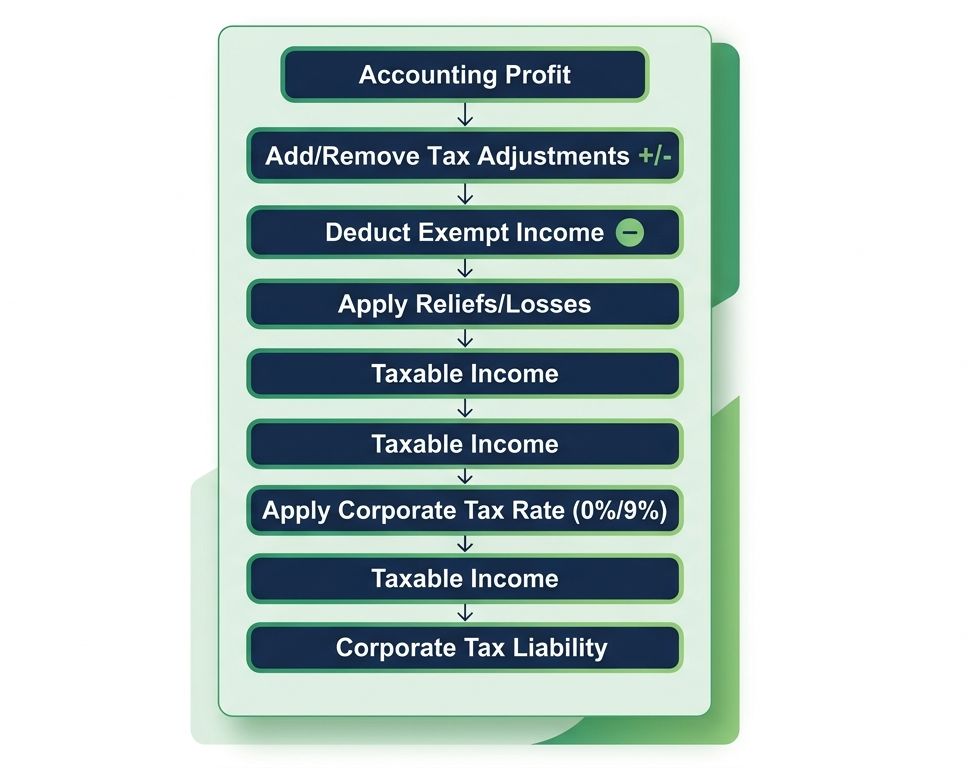
Calculating Corporate Tax liability follows a consistent sequence, moving from a business’s accounting results through to its final tax liability.
The starting point is accounting profit, the net profit reported in the business’s financial statements. Tax adjustments are then added or removed, correcting for items treated differently under the Corporate Tax Law than under accounting standards. Exempt income is deducted next, removing any qualifying dividends, exempt capital gains, or other exempt income categories from the calculation. Any applicable reliefs or available tax losses are then applied, arriving at the final taxable income figure. The relevant Corporate Tax rates are applied to that taxable income, producing the Corporate Tax liability for the period.
A simplified fictional example illustrates the sequence. A UAE trading company reports accounting profit of AED 900,000 for its Tax Period. Tax adjustments add back AED 50,000 of non-deductible entertainment expenditure. The company also received AED 100,000 in qualifying dividends from another UAE company, which is deducted as exempt income. No tax losses or other reliefs apply for this period. Taxable income is therefore AED 900,000 plus AED 50,000 minus AED 100,000, equaling AED 850,000. Applying the standard rates, the first AED 375,000 is taxed at 0 percent, and the remaining AED 475,000 is taxed at 9 percent, producing a Corporate Tax liability of AED 42,750 for the period.
This example is illustrative only. Actual Corporate Tax calculations depend entirely on a taxpayer’s specific facts, applicable elections, and the current Corporate Tax legislation and FTA guidance in force for the relevant Tax Period.
30. Corporate Tax Compliance Checklist for UAE Businesses
- Determine whether the business is a taxable person under UAE Corporate Tax Law
- Register with the FTA and obtain a Tax Registration Number
- Identify the business’s Tax Period
- Maintain accurate, complete accounting records throughout the period
- Review expenses to confirm which are deductible and which are not
- Assess related party and connected person transactions for transfer pricing compliance
- Review Free Zone status and QFZP conditions where relevant
- Calculate taxable income, applying all required adjustments, exemptions, and reliefs
- File the Corporate Tax return by the applicable deadline
- Pay any Corporate Tax due by the same deadline
- Maintain supporting documents for every position taken in the return
- Monitor regulatory updates, since UAE Corporate Tax guidance continues to evolve
- Complete deregistration where the business’s Corporate Tax obligations come to an end
31. Common Corporate Tax Mistakes
Several recurring mistakes account for most of the Corporate Tax compliance problems UAE businesses encounter. Assuming only large companies are subject to Corporate Tax leads some smaller businesses to skip registration entirely, despite registration being mandatory regardless of size or expected tax liability. Confusing VAT registration with Corporate Tax registration, treating the two as a single combined obligation, causes some businesses to miss one requirement while believing they have already met it through the other.
Assuming Free Zone companies are automatically exempt overlooks that QFZP status must be actively maintained through specific conditions, not assumed from Free Zone incorporation alone. Incorrectly calculating taxable income, whether by starting from revenue rather than accounting profit, or missing required tax adjustments, produces an unreliable return regardless of how carefully the rest of the filing is prepared. Claiming non-deductible expenses, such as fines, penalties, or non-qualifying donations, understates taxable income and creates exposure if identified in a review.
Missing registration deadlines and missing filing deadlines both trigger administrative penalties independently of each other and of any tax actually owed. Poor record keeping undermines a business’s ability to support its return if questioned, regardless of whether the underlying figures were correct. Ignoring transfer pricing obligations on related party transactions, assuming they only apply to large multinationals, leaves many UAE businesses with genuine but unaddressed compliance gaps. Failing to monitor legislative updates leaves businesses relying on outdated rules in an area that continues to evolve through new Cabinet Decisions, Ministerial Decisions, and FTA guidance. Incorrect deregistration, whether deregistering too early while obligations remain outstanding, or failing to deregister at all once a business ceases, both create avoidable compliance exposure.
Conclusion
UAE Corporate Tax touches nearly every business operating in the country, from a small sole proprietorship assessing whether its turnover crosses the registration threshold, to a large multinational group managing Qualifying Free Zone Person status, transfer pricing documentation, and Corporate Tax Group filings across multiple entities. The framework rests on a consistent core: identifying taxable persons, calculating taxable income from accounting profit through required adjustments, applying the 0 percent and 9 percent rate structure, and meeting registration, filing, payment, and record-keeping obligations on time.
Because UAE Corporate Tax continues to develop through new Cabinet Decisions, Ministerial Decisions, and FTA guidance, treating compliance as an ongoing responsibility, not a one-time setup task, is what keeps a business genuinely protected as the rules evolve. This guide covers the complete framework at an overview level; the dedicated guides linked throughout, covering registration, filing, Free Zone rules, penalties, tax losses, and transfer pricing in full depth, are the next step for any business working through a specific Corporate Tax question.
Frequently Asked Questions About UAE Corporate Tax
What is Corporate Tax in the UAE?
What is the UAE Corporate Tax rate?
When did UAE Corporate Tax start?
Who is subject to Corporate Tax in the UAE?
Who is exempt from UAE Corporate Tax?
Do Free Zone companies pay Corporate Tax?
What is a Qualifying Free Zone Person?
Do small businesses pay Corporate Tax?
Do individuals have to pay Corporate Tax?
Do sole proprietors pay Corporate Tax?
Do foreign companies pay Corporate Tax in the UAE?
Do UAE branches pay Corporate Tax?
Do I need to register for Corporate Tax if I am already registered for VAT?
How do I register for UAE Corporate Tax?
When is the Corporate Tax return due?
What is taxable income?
What expenses are deductible for Corporate Tax?
Can Corporate Tax losses be carried forward?
What is Small Business Relief?
What are Corporate Tax penalties?
What is Corporate Tax deregistration?
Is Corporate Tax the same as VAT?
What is the difference between Corporate Tax and VAT?
What is transfer pricing under UAE Corporate Tax?
What is a Corporate Tax Group?
Need Expert Advice?
Contact the team at Farahat & Co. for professional support and expert insights for businesses operating in the UAE.
How Farahat & Co. Can Help
Farahat & Co. supports UAE businesses across the full Corporate Tax lifecycle, from registration and taxable income calculation through filing, compliance, and transfer pricing documentation.
Contact Farahat & Co. today to discuss your Corporate Tax requirements.
