


An audit report is the document that tells a company, and everyone relying on its financial statements, whether those statements can actually be trusted. The specific wording an auditor chooses, unqualified, qualified, adverse, or disclaimer, changes what lenders, investors, and regulators are willing to assume about the business. Misreading which type of opinion a company has received, or not understanding what triggers each one, is a common and avoidable mistake for anyone reviewing financial statements for the first time.
This guide covers the four types of audit report opinions, what each section of a standard audit report actually contains, and how an unqualified opinion differs from a qualified one in practice.
What Is an Audit Report
An audit report is the formal written statement an external auditor issues after examining a company’s financial statements and internal controls. It contains the auditor’s findings and their professional opinion on whether those statements are fairly presented in accordance with the applicable accounting framework, typically IFRS. For UAE mainland companies, annual audits sit within the framework of Federal Law No. 32 of 2021 on Commercial Companies, and under Ministerial Decision No. 84 of 2025, audited financial statements are mandatory for all Qualifying Free Zone Persons, all Tax Groups, and any taxable person with revenue above AED 50,000,000, regardless of legal structure.
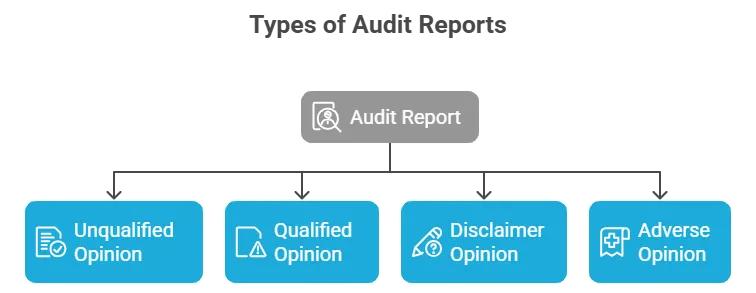
The 4 Types of Audit Report Opinions
| Opinion type | What it means |
|---|---|
| Unqualified opinion | The financial statements are fairly presented and follow the applicable accounting standards, with no material issues found |
| Qualified opinion | The auditor cannot issue an unqualified opinion because of a specific, limited issue, such as a departure from accounting standards in one area, but the rest of the statements are reliable |
| Disclaimer of opinion | The auditor cannot form an opinion at all, usually because of a significant scope limitation, missing records, or lack of management cooperation |
| Adverse opinion | The financial statements contain material misstatements that are pervasive, meaning the statements as a whole cannot be relied on and possible fraud may be involved |
As a worked example: an auditor reviewing a manufacturing company finds that inventory is materially overstated because obsolete stock was never written down, but every other account is accurate and well-supported. That single, contained issue produces a qualified opinion, “except for” the inventory valuation. If the same company’s management had refused to provide access to inventory records at all, the auditor would have no basis to form any opinion, resulting in a disclaimer instead. If overstated inventory turned out to be one symptom of systematic misstatement across revenue, receivables, and cash as well, the opinion would move to adverse.
Also check: Audit Services in UAE
Need Expert Advice?
Contact the team at Farahat & Co. for professional support and expert insights for businesses operating in the UAE.
Unqualified Versus Qualified Audit Report: What Changes
| Aspect | Unqualified report | Qualified report |
|---|---|---|
| Auditor’s opinion | Clean, financial statements present a true and fair view | Modified, “except for” specific issues identified |
| Material misstatements | None identified | Identified, but not pervasive |
| Scope limitation | None, full audit performed | Possible limitation in specific areas |
| Reliability | High, stakeholders can rely on the statements as a whole | Lower in the qualified area specifically, warrants further inquiry there |
| Impact on stakeholders | Strong confidence for investors and lenders | Raises questions in the qualified area, may affect financing or investment decisions |
What’s in the Auditor’s Opinion Section
The Auditor’s Opinion is the most critical part of the report. It states whether the financial statements give a true and fair view in accordance with the applicable framework, and explains how the audit was conducted, typically referencing International Standards on Auditing (ISA) or Generally Accepted Auditing Standards (GAAS). Evidence is gathered through inspecting records, interviews, and testing internal controls.
For listed entities, the report also includes Key Audit Matters (KAMs), disclosed under ISA 701, which highlight the areas of greatest risk or judgment in the audit, such as revenue recognition, asset impairment, or going concern assumptions. Additional sections typically cover management’s responsibility for preparing the financial statements and internal controls, and the auditor’s own responsibility for assessing risk and forming an opinion.
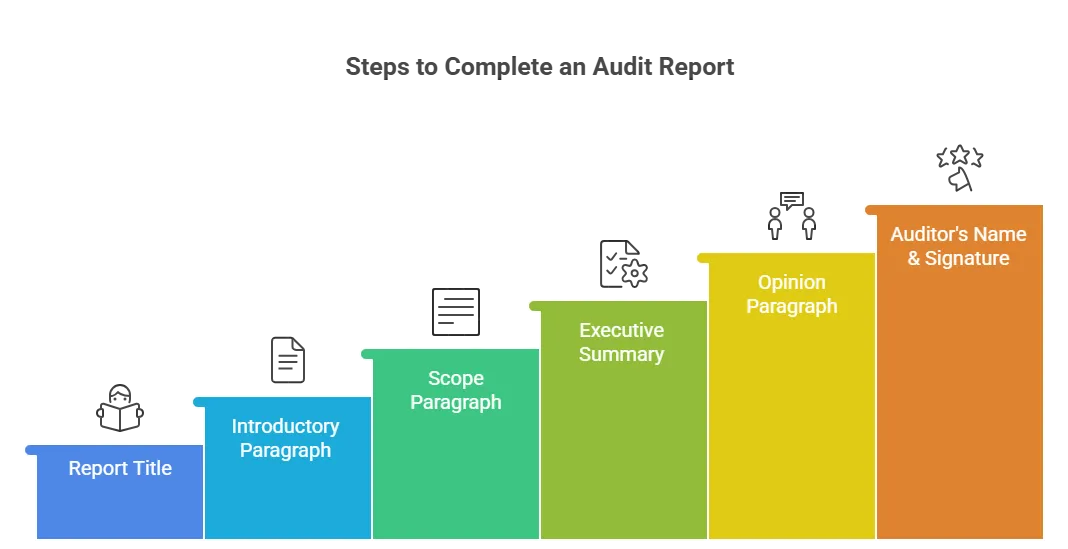
The 7 Parts of an Audit Report
- Report title. States the date, usually the last day of fieldwork, and the addressee, typically the shareholders or board of directors.
- Introductory paragraph. States that an audit was carried out, identifies which financial records were examined, and confirms that responsibility for the accuracy of the financial statements sits with the company, not the auditor.
- Scope paragraph. States that the audit followed applicable auditing standards, intended to give reasonable assurance that the financial statements are free of material misstatement.
- Executive summary. Summarizes the auditor’s findings, the matters they consider important for management to know, without yet stating an opinion on them.
- Opinion paragraph. States the auditor’s conclusion, unqualified, qualified, adverse, or disclaimer, along with the basis for reaching it.
- Auditor’s name. Identifies the auditor or, where the auditor works for a firm, the firm’s name as well.
- Auditor’s signature. Confirms the auditor accepts professional responsibility for the report’s conclusions.
The 5 C’s of Audit Reporting
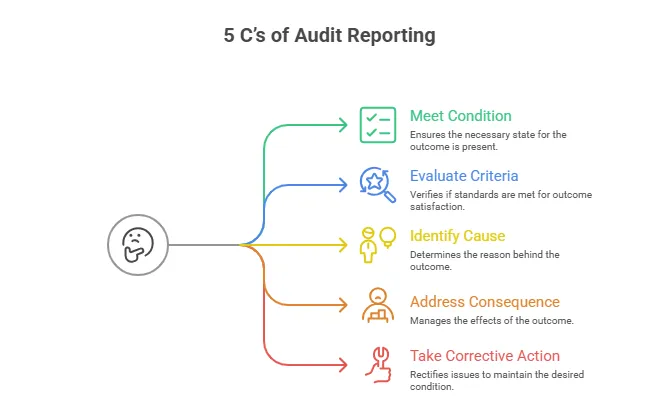
The 5 C’s are a common framework for structuring individual findings within an audit report, particularly for internal control or compliance issues:
- Condition: the situation being reviewed
- Criteria: the standard or benchmark the condition is measured against
- Cause: why the issue occurred
- Consequence: the impact of the issue if left unaddressed
- Corrective action: the steps needed to resolve it
Audit Report Preparation and Best Practices
Planning and scope. Define audit objectives, scope, and materiality thresholds clearly at the outset, and prepare a schedule that sequences tasks across the audit team.
Standards and regulations. Follow ISA or GAAS as applicable, and align with UAE regulatory requirements, including Federal Law No. 32 of 2021 for annual audit obligations. Sector-specific standards, such as data protection requirements for healthcare entities, may also apply.
Evidence gathering. Review documentation, invoices, receipts, meeting minutes, and internal policies, and test internal controls such as segregation of duties, authorization protocols, and management oversight. Interviews and substantive testing round out the evidence base.
Technology and documentation. Audit software and data analytics tools improve both efficiency and depth, and every finding and decision should be clearly documented as the audit progresses, not reconstructed afterward.
Report drafting and review. Follow a clear structure, title, addressee, opinion, basis of opinion, and include Key Audit Matters where relevant. Management review should take place before the report is finalized.
Stakeholder communication. Present findings to the board or audit committee, provide recommendations for risk reduction and control improvements, and follow up on whether corrective actions were actually taken.
Must check: External Audit Services
Why Audit Reports Matter
- They provide independent assurance that financial statements are free from material misstatement and follow the applicable framework
- They build trust among investors, creditors, and lenders who rely on the statements to make decisions
- They support future decision-making by surfacing risks in internal controls, governance, or financial reporting
- They are a compliance requirement under UAE corporate governance and Corporate Tax regulations for many entities
- They improve accountability and, over time, the overall quality of management and governance
UAE Audit Reports in Practice
UAE auditors must follow International Standards on Auditing when preparing their reports. For free zone companies, the audit report typically forms part of the entity’s regulatory submission and must be prepared by a licensed auditor who is independent of the company being audited, with the report meeting the formal structure required under the relevant free zone’s annual accounts guidance. For listed entities globally, including those with UAE operations, audit reports increasingly disclose Key Audit Matters under ISA 701, covering areas such as revenue recognition, asset impairment, or going concern assumptions.
See also: Corporate Tax Audit in UAE
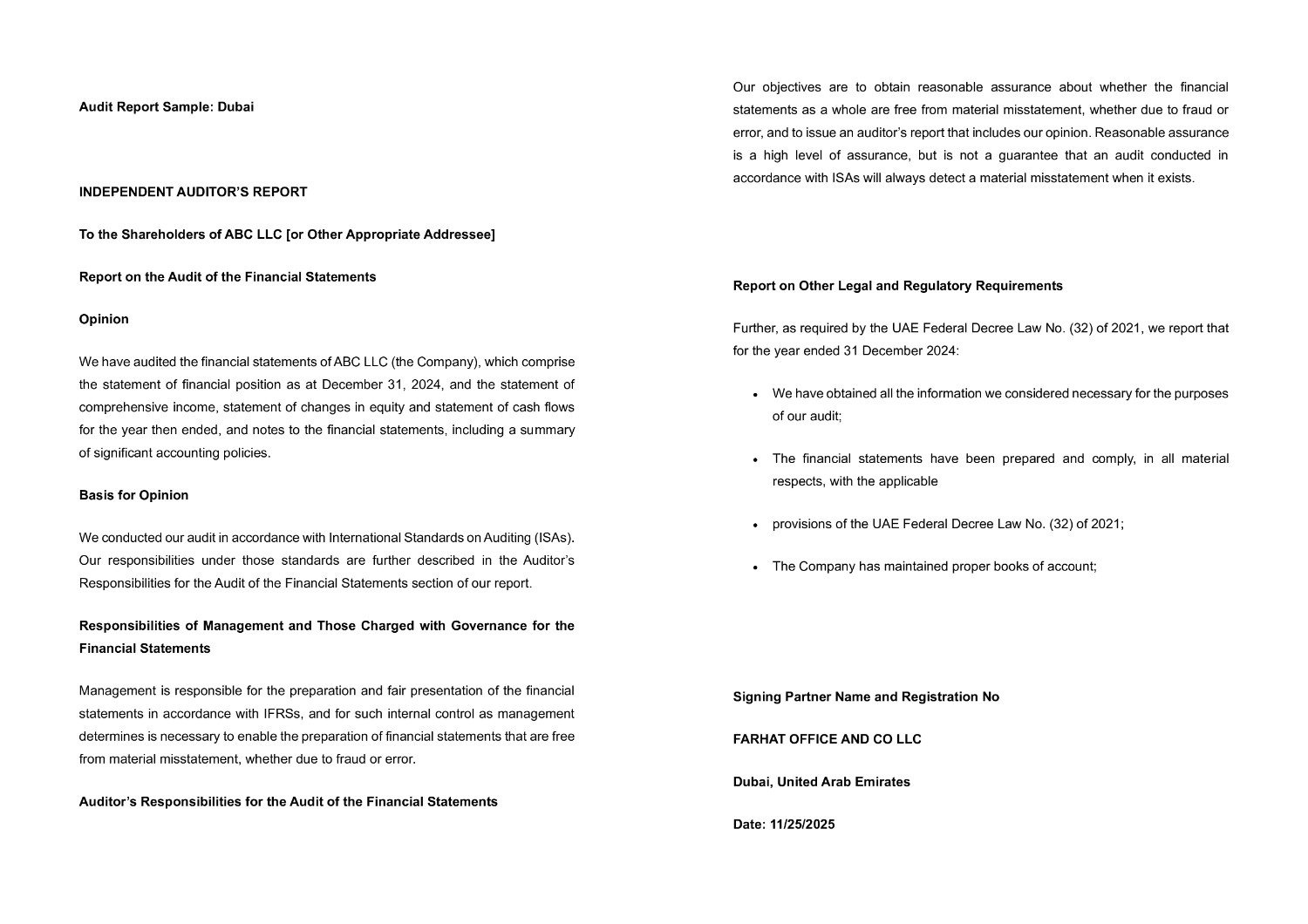
Audit Report Sample (Downloadable Template & PDF)
You can download the sample format from below.
Audit Report word/pdf sample:-Download Now
Frequently Asked Questions (FAQs)
What are the 4 types of audit report opinions?
What is the difference between a qualified and an unqualified audit report?
What is an adverse audit opinion?
Why would an auditor issue a disclaimer of opinion?
Who can sign an audit report in the UAE?
Are audit reports mandatory for all companies in the UAE?
What are Key Audit Matters in an audit report?
Need Expert Advice?
Contact the team at Farahat & Co. for professional support and expert insights for businesses operating in the UAE.
How Farahat & Co. Can Help
Farahat & Co. prepares audit reports for UAE mainland and free zone entities, including statutory audits, Corporate Tax-mandated audits, and reports covering Key Audit Matters for entities that require them.
Contact Farahat & Co. today to discuss your audit report requirements.
