


An audit report tells everyone who relies on a company’s financial statements whether those numbers can be trusted. Banks, free zone authorities, the FTA and investors all read the same report, and most of them start with one paragraph: the auditor’s opinion. The type of opinion, and any extra paragraph that follows it, decides how many questions come next.
This guide explains the four types of audit opinion with sample wording for each, the paragraphs that can appear without changing the opinion, how a standard audit report is laid out under International Standards on Auditing (ISA), and what each result means for a UAE company in practice.
Need your audit done this season? Farahat & Co. has audited UAE mainland and free zone companies since 1985. Message us on WhatsApp or request a quote.
What Is an Audit Report?
An audit report is the independent auditor’s written conclusion on a company’s financial statements. It states whether those statements give a true and fair view, in all material respects, under the applicable financial reporting framework. In the UAE, that framework is usually IFRS Accounting Standards, or IFRS for SMEs where the company qualifies.
An audit gives reasonable assurance, not absolute assurance. A clean report means the auditor found no material misstatement after testing. It does not certify that every figure is exact or that no fraud ever took place.
In the UAE, mainland limited liability companies and joint stock companies must appoint an auditor under Federal Decree-Law No. 32 of 2021 on Commercial Companies. Free zones set their own annual audit rules. For corporate tax, Ministerial Decision No. 84 of 2025 requires audited financial statements from all Qualifying Free Zone Persons, all tax groups, and any taxable person with revenue above AED 50 million. Our guide to audit requirements in the UAE covers who needs an audit in more detail.
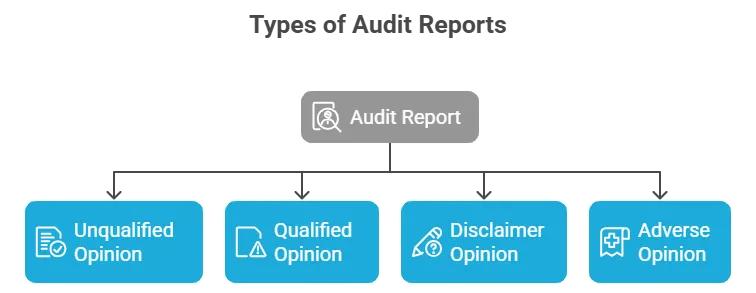
The 4 Types of Audit Opinion
Under ISA 700 and ISA 705, there is one unmodified opinion and three modified ones. The auditor picks between them by answering two questions: is there a material problem, and is that problem pervasive?
| Opinion | When the auditor issues it | What a reader takes from it |
|---|---|---|
| Unqualified (unmodified) | The auditor obtained enough evidence and found no material misstatement | The statements can be relied on as a whole |
| Qualified | A material misstatement exists but is not pervasive, or the auditor could not obtain evidence for one area and the possible effect is material but not pervasive | The statements can be relied on, except for the area named in the report |
| Adverse | Misstatements are both material and pervasive | The statements as a whole do not give a true and fair view |
| Disclaimer of opinion | The auditor could not obtain sufficient evidence, and the possible effects could be both material and pervasive | The auditor expresses no opinion at all |
“Pervasive” has a specific meaning in ISA 705. A problem is pervasive when it is not confined to one area of the statements, when it affects a substantial part of them even if it sits in one area, or when it concerns a disclosure that is fundamental to understanding the statements.
Sample Opinion Wording for Each Type
The wording below is illustrative, based on the standard ISA format, for a fictional company, ABC Trading LLC, with a 31 December 2025 year end.
| Opinion | Sample wording |
|---|---|
| Unqualified | “In our opinion, the accompanying financial statements present fairly, in all material respects, the financial position of ABC Trading LLC as at 31 December 2025, and its financial performance and its cash flows for the year then ended in accordance with IFRS Accounting Standards.” |
| Qualified | “In our opinion, except for the effects of the matter described in the Basis for Qualified Opinion section of our report, the accompanying financial statements present fairly, in all material respects…” Basis example: inventories of AED 4.2 million include slow-moving stock that management has not written down to net realisable value, as IAS 2 requires. Had it done so, inventories and profit for the year would each have been AED 680,000 lower. |
| Adverse | “In our opinion, because of the significance of the matter discussed in the Basis for Adverse Opinion section of our report, the accompanying financial statements do not present fairly the financial position of ABC Trading LLC as at 31 December 2025…” Basis example: the company recognised revenue on contracts before performing its obligations. This misstates revenue, receivables, contract liabilities and profit across the statements. |
| Disclaimer | “We do not express an opinion on the accompanying financial statements of ABC Trading LLC. Because of the significance of the matters described in the Basis for Disclaimer of Opinion section of our report, we have not been able to obtain sufficient appropriate audit evidence to provide a basis for an audit opinion on these financial statements.” Basis example: accounting records for most of the year were lost in a system migration, so revenue, purchases and inventory could not be verified. |
One Problem, Three Possible Outcomes
Take a manufacturing company where obsolete stock was never written down, but every other account is accurate. That contained issue leads to a qualified opinion, “except for” inventory.
Now suppose the auditor could not attend the year-end stock count and had no other way to verify inventory. The result depends on size. If inventory is material but the rest of the statements are sound, the opinion is qualified. If inventory is so large that the auditor cannot conclude on the statements as a whole, it becomes a disclaimer.
If the overstated stock turns out to be one symptom of wider misstatement across revenue, receivables and cash, the opinion moves to adverse. An adverse opinion is a finding about the numbers. It does not, by itself, mean fraud took place.
Expert note from the Farahat Audit Team: In owner-managed companies, most qualified opinions trace back to two areas: inventory that was never counted at year end, and customer balances that cannot be confirmed. Both are fixable before year end. Plan a stock count and invite your auditor to attend, and reconcile and chase customer balances in December, not in March.
Need Expert Advice?
Contact the team at Farahat & Co. for professional support and expert insights for businesses operating in the UAE.
Unqualified vs Qualified Audit Report: What Changes
| Aspect | Unqualified report | Qualified report |
|---|---|---|
| Opinion wording | “Present fairly, in all material respects” | “Except for the effects of the matter described…” |
| Material misstatement | None found | Found in a specific area, not pervasive |
| Evidence | Sufficient for all areas | May be missing for one specific area |
| Extra section | Basis for Opinion | Basis for Qualified Opinion, explaining the issue and, where possible, its amount |
| Effect on readers | Banks and authorities usually accept it without follow-up | Expect questions on the qualified area, and possibly on financing terms |
Paragraphs That Do Not Change the Opinion
Some sections draw attention to a matter without modifying the opinion. Readers often mistake them for qualifications.
Material uncertainty related to going concern (ISA 570). When events cast significant doubt on the company’s ability to continue operating, and management has disclosed this properly, the auditor adds a separate section with this heading. The opinion stays unmodified. If the disclosure is inadequate, the opinion becomes qualified or adverse. If the going concern basis itself is inappropriate, the opinion is adverse. Banks read this section as closely as the opinion itself.
Emphasis of matter (ISA 706). This points readers to something already disclosed correctly in the notes that is fundamental to understanding the statements, such as major litigation or a significant event after year end.
Other matter (ISA 706). This covers points relevant to the audit itself rather than the statements, such as the prior year being audited by another firm, or not audited at all.
Expert note from the Farahat Audit Team: If your company made a loss or has net liabilities, prepare a 12-month cash flow forecast before fieldwork starts. Where shareholders will fund the company, have them sign a support letter early. Raising going concern late is one of the most common reasons an audit report is delayed.
What a Standard Audit Report Contains (ISA 700)
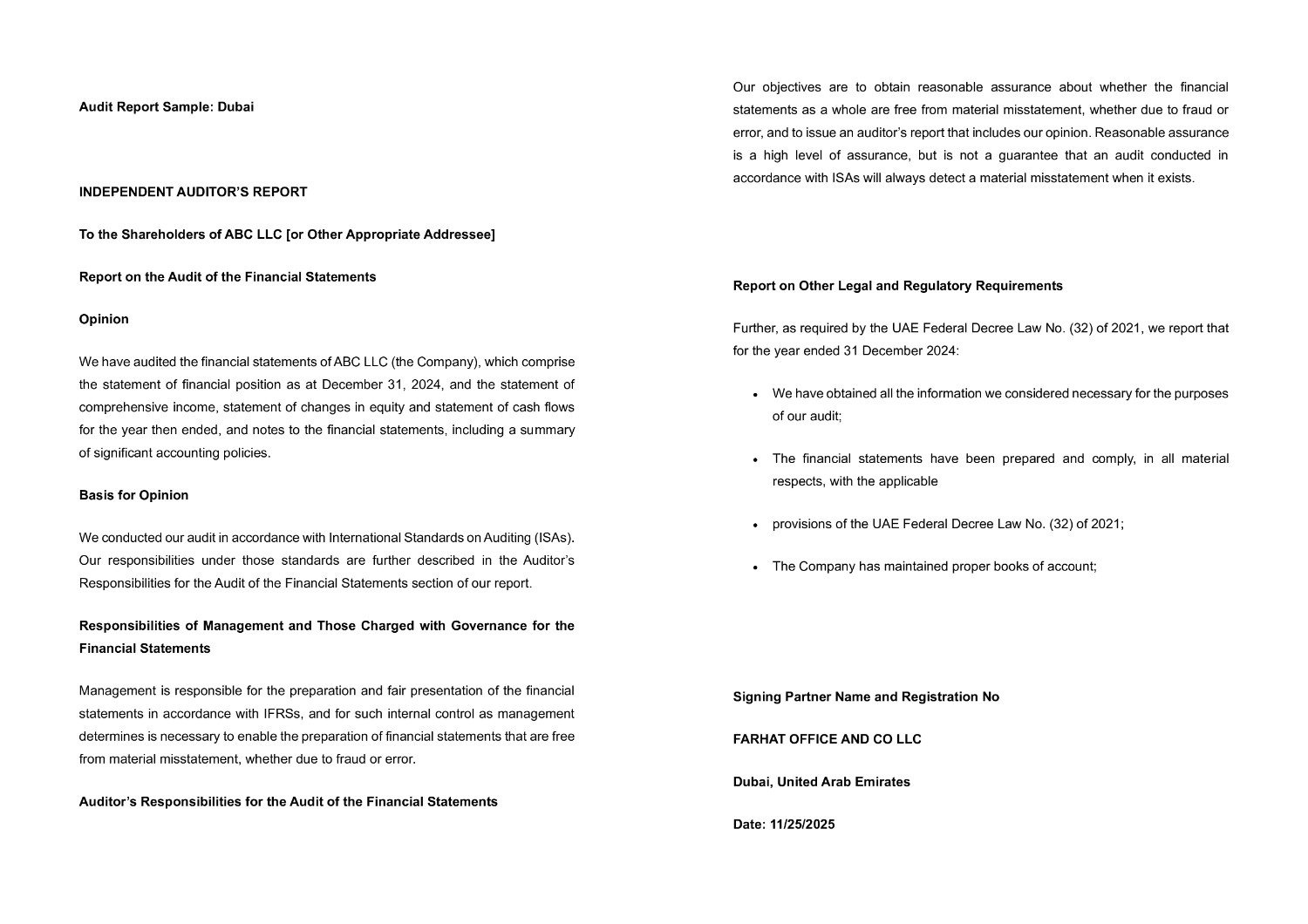
Under the current ISA 700 format, an audit report follows this order:
- Title. “Independent Auditor’s Report”, which confirms the auditor is independent of the company.
- Addressee. Usually the shareholders.
- Opinion. Placed first, so readers see the conclusion before anything else.
- Basis for opinion. Confirms the audit followed ISA, that the auditor is independent under the relevant ethics code, and that the evidence obtained is sufficient. For a modified opinion, this section explains the issue.
- Going concern. A separate section, only when a material uncertainty exists.
- Key audit matters. Required for listed entities under ISA 701. These are the areas of greatest audit judgment, such as revenue recognition or impairment.
- Other information. Covers documents published with the statements, such as the directors’ report (ISA 720).
- Responsibilities of management and those charged with governance. Management prepares the statements and runs internal controls.
- Auditor’s responsibilities. What the audit involves and the limits of reasonable assurance.
- Report on other legal and regulatory requirements. UAE mainland reports usually confirm matters required by the Commercial Companies Law, such as whether proper books were kept and whether the auditor noted breaches that would materially affect the company’s financial position.
- Signature, location and date. The report is dated no earlier than the day the auditor obtained sufficient evidence, including management’s approval of the statements. It is not simply the last day of fieldwork.
Some older guides describe a “seven-part” report with a scope paragraph and an executive summary. That is an older format and is not how ISA reports are structured today.
How Banks, Free Zones and the FTA Read Your Audit Report
- Banks read the opinion first, then look for a going concern section. Facility agreements often require audited accounts within a set period, and a modified opinion usually leads to questions before any renewal or new limit.
- Free zone authorities in many zones require the audited statements for licence renewal. The report must come from an auditor on that zone’s approved or registered list, so check your zone portal before appointing one.
- The FTA relies on audited statements where Ministerial Decision No. 84 of 2025 requires them. Companies must prepare and keep them, and the FTA can ask for them.
- Buyers and investors treat the opinion as a starting point in due diligence. A qualification usually becomes a price or warranty discussion.
For a walk-through of the statements that sit behind the report, see our guide to audited financial statements.
Who Can Sign an Audit Report in the UAE?
For mainland companies, the report must be signed by an auditor registered with the Ministry of Economy as a practising auditor, working through a licensed audit firm. A professional qualification alone, without that registration, is not enough.
Free zones add their own layer. Zones such as DMCC and ADGM keep their own approved or registered auditor lists. In the DIFC, most companies need a DIFC-registered auditor, while firms regulated by the Dubai Financial Services Authority need a DFSA-registered auditor. See our free zone audit services page for the zones we cover.
Internal Audit Reports and the 5 C’s
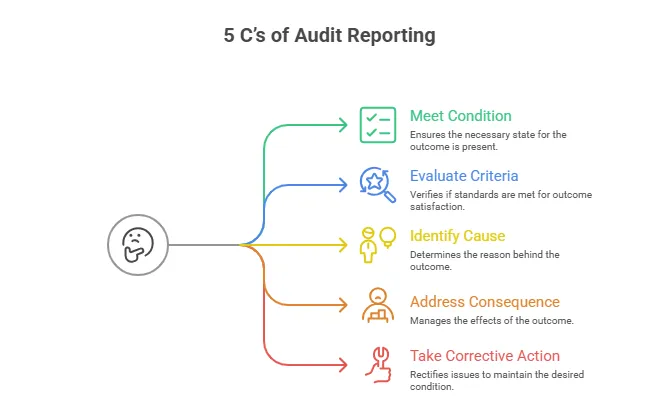
The 5 C’s apply to internal audit and compliance reports, not to the external auditor’s opinion. Internal auditors use them to set out each finding clearly for management and the board:
- Condition: what the auditor found
- Criteria: the policy, standard or rule it is measured against
- Cause: why the gap occurred
- Consequence: the risk or cost if it is not fixed
- Corrective action: what should be done, by whom and by when
More on this in our internal audit services.
How to Prepare for a Clean Audit Opinion
- Reconcile bank accounts, receivables and payables before the auditor arrives.
- Count inventory at year end and invite the auditor to observe.
- Support related party balances with agreements and signed confirmations.
- Keep a fixed asset register that agrees with the ledger.
- Prepare a cash flow forecast if the company made a loss.
- Name one person to answer audit queries, and approve the draft report quickly.
For the full process and timeline, read our guide to the annual statutory audit in Dubai.
Audit Report Sample (Word and PDF)
Download a sample audit report format to see how the sections fit together.
Download the audit report sample (Word / PDF)
Frequently Asked Questions (FAQs)
What are the 4 types of audit report opinions?
What is the difference between a qualified and an unqualified audit report?
Is an emphasis of matter paragraph a qualified opinion?
Does an adverse opinion mean fraud?
Why would an auditor issue a disclaimer of opinion?
Who can sign an audit report in the UAE?
Are audit reports mandatory for all companies in the UAE?
What are key audit matters in an audit report?
Need Expert Advice?
Contact the team at Farahat & Co. for professional support and expert insights for businesses operating in the UAE.
How Farahat & Co. Can Help
Farahat & Co. has audited UAE mainland and free zone companies since 1985, including statutory audits and audits required for corporate tax. Our external audit services start with a written timeline, so you know what to prepare and when your report will be ready.
Contact Farahat & Co. to plan your audit for this season.
