
A new era is emerging in the employment market of the UAE as it enters the year 2026. Economic growth, the shift away from oil, digitalization, and an increasingly more competitive battle for human resources are defining compensation trends in the Emirates. Companies are asking themselves what their compensation structures should look like in order to remain more competitive, whereas employees are becoming more discerning about their work.
This article explains which sectors are expected to see the highest salary increases in 2026, which roles will command premium pay, and why salaries in the UAE are likely to rise, based on market data, economic drivers, and workforce trends.
What UAE Sectors are Expected to Record the Largest Salary Rises in 2026?
The UAE salary forecast 2026 points to moderate but steady wage growth across most industries. According to various market studies, the average salary increase projected for various industries is pegged at 4.1 percent, with some industries exceeding the average levels of growth.
There is no standard salary increase in 2026. This is because it is being fueled by industries that boost the UAE’s non-oil economy digital transformation plan.
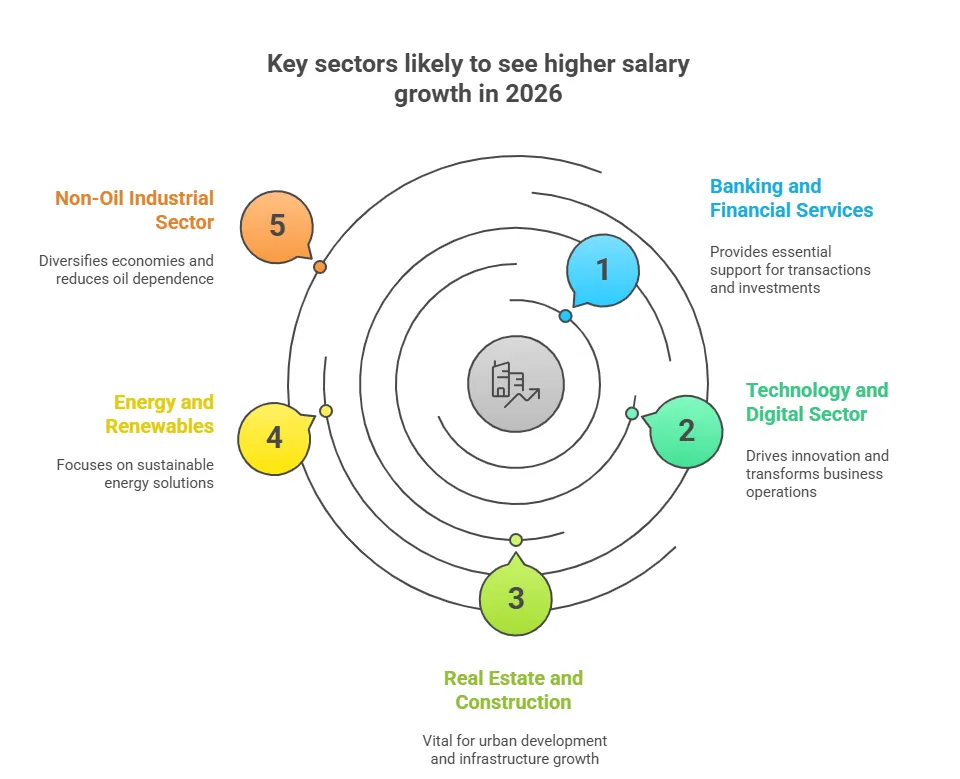
Key sectors likely to see higher salary growth
| Sector | Why Salaries Are Rising |
|---|---|
| Banking and financial services | Regulatory complexity, compliance requirements, and demand for risk and governance professionals |
| Technology and digital sector | AI adoption, cybersecurity needs, data analytics, and automation projects |
| Real estate and construction | Large-scale developments, infrastructure pipelines, and population growth |
| Energy and renewables | Transition to clean energy, sustainability goals, and specialist engineering roles |
| Non-oil industrial sector | Manufacturing, logistics, and supply chain expansion |
“The UAE remains singularly focused on foreign investment attraction and private sector development, which is driving wages in such high-demand industries,” explains an Euromoney report on the topic.
Your Business Solution
Dubai’s Expert Advice at Your Fingertips

What Roles Will Command a Commanding Salary Package Next Year In The UAE?
Instead, in 2026, raises for wages will be more about specialist skills and less about titles. Those that are hard to replace, more technical, or important for compliance or strategic purposes would get the best rewards.
High-paying roles expected in 2026
| Role | Reason for Higher Pay |
|---|---|
| AI Engineers | Scarcity of talent and high impact on business automation |
| Data Scientists | Demand for real-time insights and predictive analytics |
| Compliance Officers | Increased regulatory pressure across finance, real estate, and payroll |
| Risk Managers | Managing financial, operational, and cyber risks |
| Renewable Energy Engineers | Clean energy projects and sustainability targets |
| Sustainability Consultants | ESG reporting and regulatory alignment |
| Project Directors & Project Managers | Oversight of complex, multi-million-dirham developments |
| HR Directors | Workforce transformation and talent retention strategies |
| Private Bankers & Wealth Managers | Growth in high-net-worth clients and cross-border investments |
These roles are severely connected with business continuity, governance, or value creation, which is the reason that the company is willing to trade more for such talent.
How Are UAE Employers Modifying Their Compensation Programs for Retaining Talents?
With such a competitive labour market, employers are no longer dependent on wage increases. Today, they are reorienting their compensation plans for more innovative techniques to recruit and retain qualified personnel.
Common strategies of employers in 2026
- Moving towards a skills-based pay structure rather than fixed job bands
- Offering clearer career development pathways
- Introducing retention bonuses for critical roles
- Investing in leadership development and succession planning
- Enhancing benefits linked to wellbeing, flexibility, and learning
Organizations are also re-evaluating their workforce structure to provide compensation that drives productivity in the long term, besides meeting the need for labor in the short term.
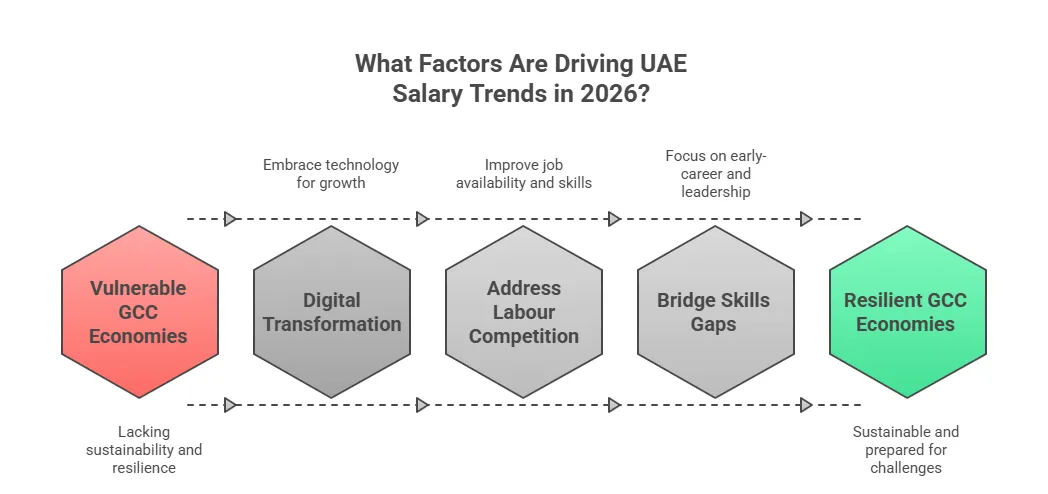
What Factors Are Driving UAE Salary Trends in 2026?
There are various structural as well as economic elements that are currently influencing the projected salary rise 2026 in the UAE.
Key drivers behind salary growth:
1. Economic growth and diversification
The UAE is still developing its non-oil economy through technology, finance, logistics, and industrial development. This is driving the constant need for expertise.
2. Digital transformation
Automation, AI, and data-based decisions drive up labour demands in technical areas, causing wages to escalate.
3.Labour market competition
This is partly due to the rapid growth of Dubai’s population, as other emirates in the UAE also face stiff competition for skilled human resource services.
4.GCC dynamics
Regional competition, including transformation programmes in Saudi Arabia and growth in Qatar and Oman, is influencing salary benchmarking across the GCC.
5.Early-career and leadership gaps
Employers are investing more in young professionals and leadership pipelines to address future skills shortages, which impacts overall compensation planning.
Your Business Solution
Dubai’s Expert Advice at Your Fingertips
What This Means for Employers in the UAE ?
For employers, the UAE salary forecast 2026 highlights the need for proactive planning. Businesses that delay reviewing compensation structures may struggle to retain key employees, especially in high-demand roles.
Employers should:
- Regularly benchmark salaries against market data
- Focus on total reward strategies, not just base pay
- Invest in training and internal mobility
- Align compensation with long-term business goals
What Does This Means for Employees and Job Seekers ?
For professionals, 2026 presents opportunities, particularly for those with specialist skills or experience in growth sectors. However, salary growth will favour individuals who can demonstrate value, adaptability, and long-term potential.
Employees should:
- Invest in upskilling and certifications
- Focus on roles aligned with digital and regulatory needs
- Consider career progression alongside pay increases
Conclusion
The outlook for UAE salary growth in 2026 remains positive, supported by economic stability, sector diversification, and demand for specialist skills. While the average increase is expected to be moderate, certain sectors and roles will experience significantly higher pay growth.
Both employers and employees who plan early, adapt to market shifts, and focus on long-term value will be best positioned to benefit from the evolving UAE job market in 2026.
